Advanced features
ESSIM supports a set of advanced features to support a multitude of use cases. This page will describe these advanced features.
Carrier prices
In many use cases prices of carriers, such as those of electricity and gas, are relevant to take in to account in
the decision to produce or consume energy. ESSIM supports these analyses by adding cost profiles to carriers (such as
ElectricityCommodity or GasCommodity). These cost will be taken automatically into account when configured.
Carrier Price Profiles
In ESDL, an EnergyCarrier can have a cost profile (of type GenericProfile, so it can be a fixed SingleValue
or some timeseries profile). ESSIM treats these profiles as exogenous prices.
Role of Carrier Price Profiles
Conversion Viability Check:
For Conversion assets (like heat pumps or electrolyzers), ESSIM uses the price profiles of the input and output carriers to determine if a conversion is economically viable at the current time step.
It calculates the weighted sum of input carrier prices and compares it with the weighted sum of output carrier prices (based on the conversion efficiencies/ratios).
If the output value is less than the input cost, the conversion node will generate a flat bid curve with zero energy (0 demand/supply), effectively disabling the conversion for that time step.
This behavior can be disabled by setting the environment variable
DISABLE_PRICE_BASED_BID_DECISIONS=truewhen starting ESSIM.
Default Marginal Cost: If a Producer or Consumer asset does not have a specific marginal cost profile defined in its CostInformation, ESSIM uses the price profile of the connected carrier as the default marginal cost.
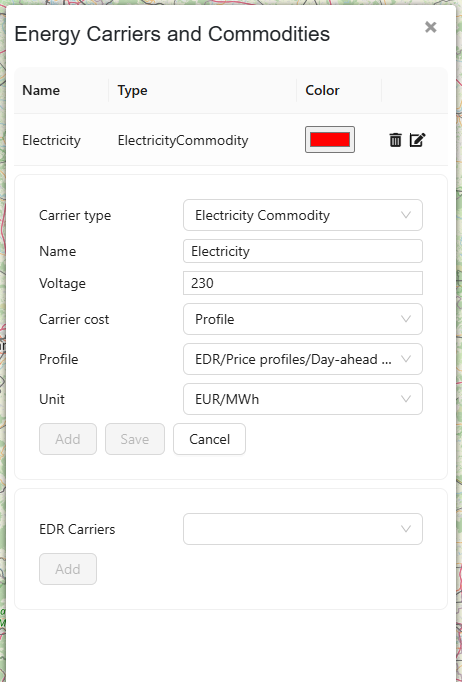
In the ESDL Mapeditor, you can add a profile to a carrier when opening the ESDL Carriers. See below for an example: